
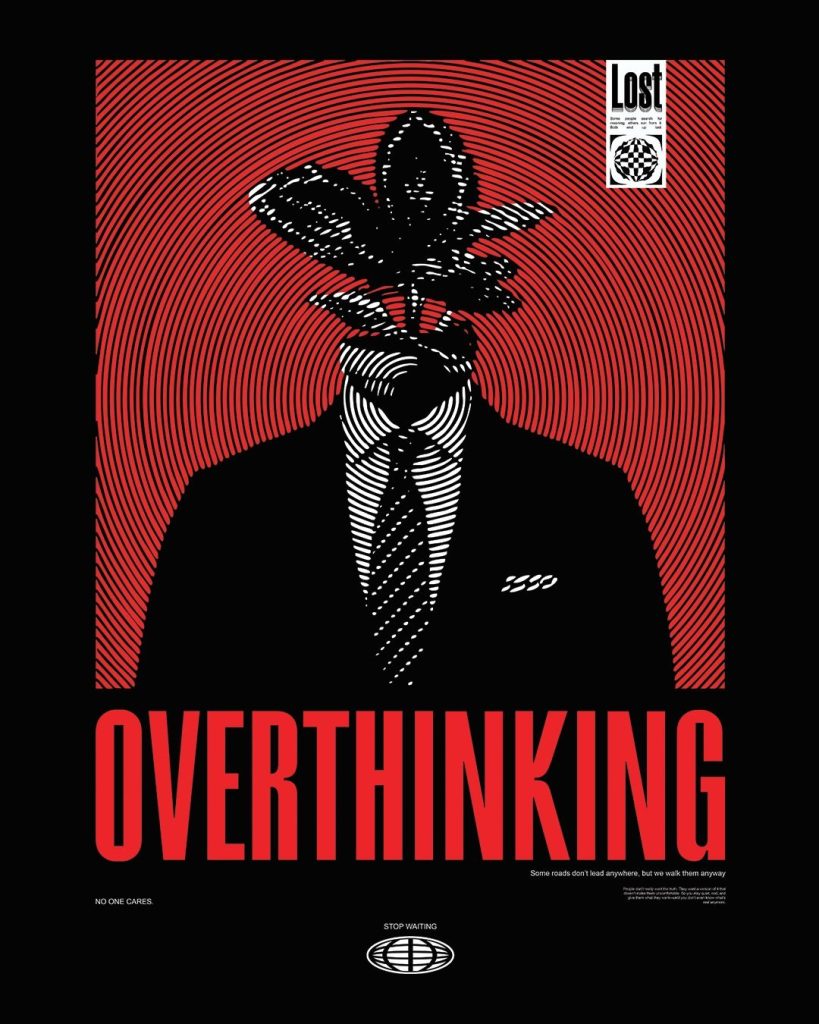
Your Brain Is Too Good at Thinking.
That's the Problem.
Why intelligent people are the most likely to be trapped by their own minds & what psychology says about the way out.
Picture this: it’s 11 PM. You said yes to something at work today, a reasonable ask by your colleague, a normal conversation. You’ve since replayed it 14 times. Should you have said no? Did they notice your hesitation? What does it say about you that you agreed so quickly? What does it say that you’re now questioning it?
This isn’t weakness. This isn’t anxiety in the clinical sense. This is intelligence doing what it was designed to do… Pattern-finding, consequence-mapping, risk-assessing, in a context where there is no real threat to solve.
And the sharper the mind, the more ruthlessly it does this.
Welcome to the intelligence trap
"Intelligence is not just about thinking well.
It's also the ability to rationalize anything — including your own suffering."
The Smartest Person in the Room Is Often the Most Stuck
In 2019, researcher David Robson challenged a common belief, ‘that being highly intelligent protects you from thinking errors’. His findings showed the opposite. People with higher intelligence can actually be more prone to certain reasoning mistakes. Not because they’re wrong more often, but because they’re better at building convincing arguments for what they already believe.
Psychologists call this “motivated reasoning.” The overthinking person isn’t someone who can’t think. They’re someone who thinks so well, so fast, so thoroughly, that their mind has already run 17 scenarios before someone has finished their sentence.
What's Actually Happening in Your Head
The Voice That Won’t Stop
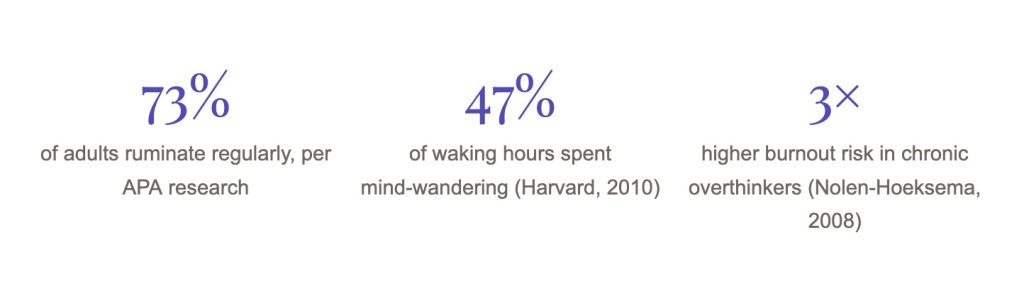
The average person spends one third of their waking life not engaged with their actual present experience, but running internal commentary about it.(Killingsworth & Gilbert, 2010)
Most people have an internal voice. But for some, it’s louder, faster, and far more convincing.
And for people with high verbal intelligence, this inner narrator is unusually loud, unusually fast, and unusually persuasive. It sounds like insight. It presents as problem-solving.
Work by Kross(2021) shows that overthinking activates the same neural regions as physical pain, the dorsal anterior cingulate cortex.
Overthinking doesn’t just feel painful. To your nervous system, it registers as pain.
The Confidence Paradox: Why High Achievers Trust Themselves Least
Here is a pattern that appears again and again in therapy with high-functioning people: the more accomplished the person, the more elaborate their relationship with self-doubt.
This gap between where you are and where you think you need to be before you can act with certainty, is seductive.
If I just think through this enough, I’ll reach clarity. If I reach clarity, I can move forward without doubt.
This cycle is not laziness. It’s not indecision. It is an intelligent mind that doesn’t have the tools to distinguish between helpful thinking and harmful looping.
The mind doesn’t need more time. It needs a different relationship with uncertainty.
When we have more information and more time, we don’t necessarily make better decisions. We just come up with more convincing explanations for why we still haven’t decided.
The 4,000 Weeks Problem
Oliver Burkeman calculated something that is worth sitting with: the average human life is approximately four thousand weeks long.
Not a metaphor. A number. And a significant portion of those weeks, for the chronic overthinker are not spent living but spent pre-living, post-living, and meta-living: rehearsing what hasn’t happened, replaying what already has, and thinking about thinking.
- You rehearse conversations in your head before they happen.
- You revisit them long after they’re done.
- And in between, you think about how you’re thinking, trying to get it “right.”
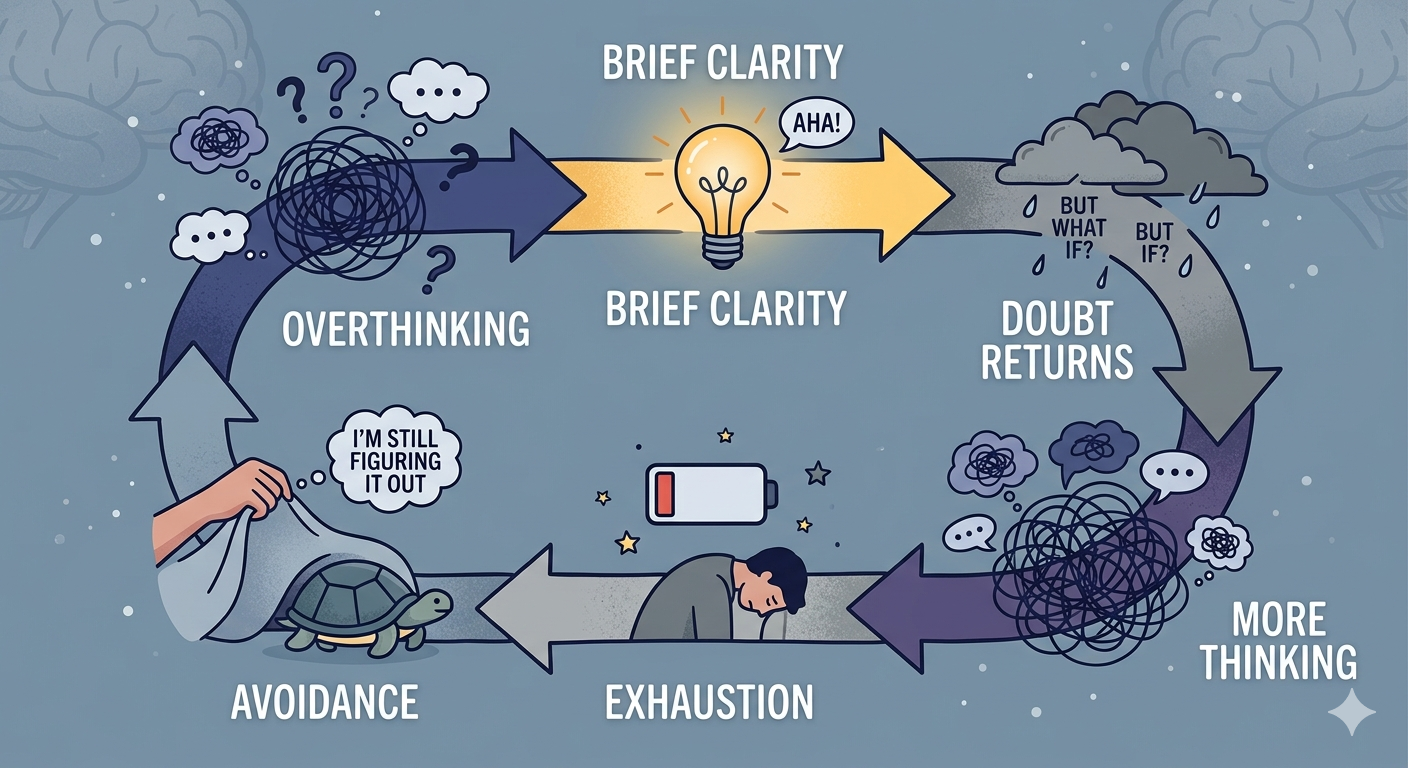
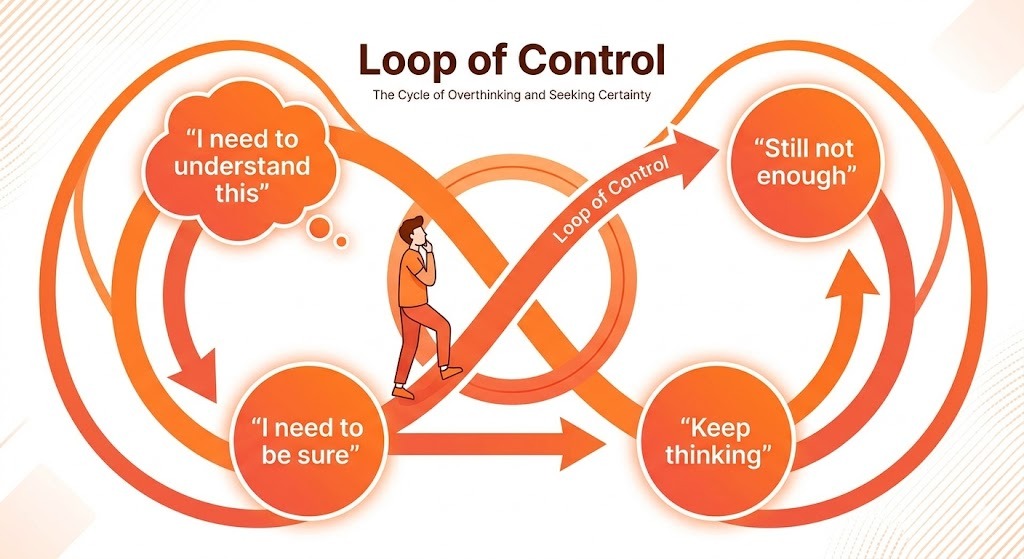
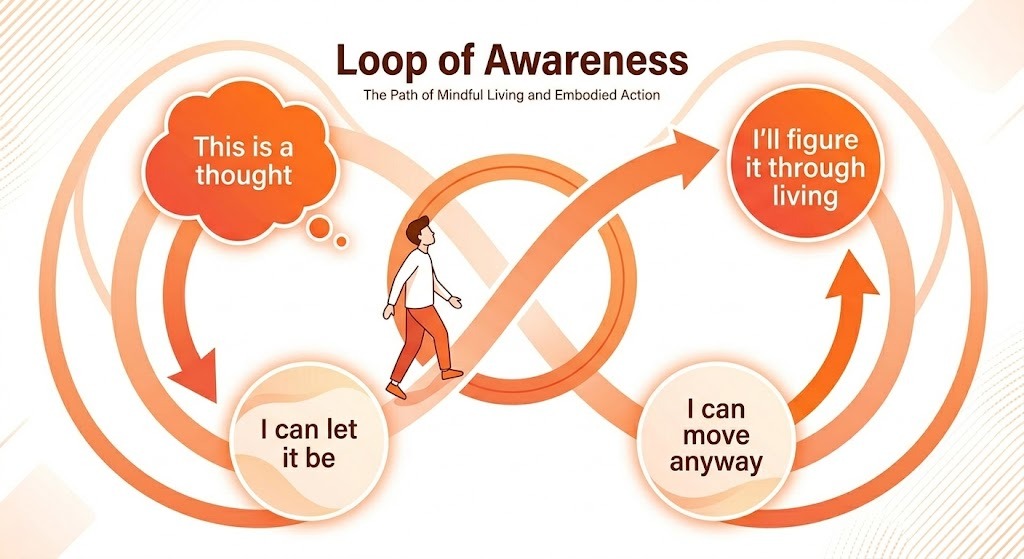
The Loop of Control feels like you’re doing the right thing, thinking carefully, trying to understand, trying to be sure. But it quietly keeps you in the same place.
The Loop of Awareness feels less certain, almost uncomfortable, because you’re no longer waiting to feel fully ready before you move. Clarity doesn’t come from thinking something through endlessly. It starts to emerge when you step out of the loop and engage with what’s actually in front of you.
Most people believe they need certainty before action. This is where that pattern shifts, action comes first, and clarity follows.
What Change Actually Looks Like
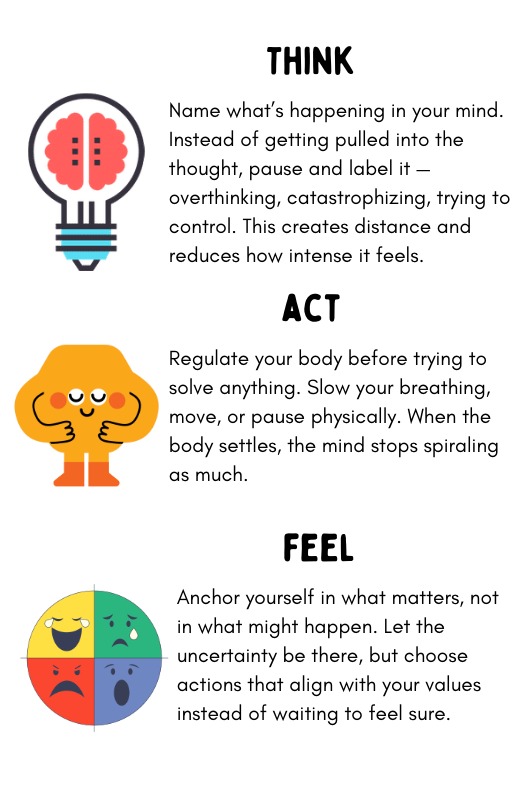
If you’re trying to get out of overthinking, the shift is not about forcing your mind to stop. It’s about changing how you relate to it. Here’s what that starts to look like in practice:
- Stop trying to solve overthinking with more thinking- This is the trap. The same mind that creates the loop cannot fully step outside of it on its own. Real change comes from stepping out of the pattern, not analyzing it endlessly.
- Start allowing imperfection instead of waiting for certainty- You don’t need to feel completely sure before you act. In fact, waiting for certainty is what keeps the loop going. Practice making small decisions even when there’s doubt, and notice that you can handle the outcome.
- Change how you define yourself- If your identity is built around being “the one who thinks things through,” you will keep returning to overthinking. The shift begins when you start seeing yourself as someone who can act, even without full clarity.
- Work with your body, not just your mind- Overthinking is not only mental, it’s physiological. When your body is in a constant state of stress, your mind will keep generating problems. Learning to slow down your body (through breath, movement, or stillness) helps interrupt the loop.
- Use a Choice Point Worksheet- When you’re overthinking, pause and notice where your mind is pulling you. Is it pushing you to delay, overanalyze, or wait for certainty? Or is there a small action you already know matters? The shift is choosing that action, even with doubt.
These aren’t self-help tips. They are evidence-based clinical mechanisms. And they require guided, sustained work, not because the person is incapable, but because the mind that is good at thinking about everything is often the last mind to be able to observe itself clearly.
free mental health tools
Download Your Overcoming Overthinking Exercise Kit Now
Our psychologists have created a toolkit of 20+ exercises for you to manage your overthinking
About The Therapist
Iknoor Kohli has been working in the field of mental health for the more than 6 years, offering therapy to individuals and couples, both online and offline. She is the founder of Ask A Therapist, a platform created to provide accessible, credible, and ethical mental health support, where people can ask questions and receive guidance they can trust. Alongside her clinical practice, she conducts trainings and workshops for corporates, schools, NGOs, and colleges, focusing on emotional wellbeing and self-awareness. She has also collaborated with institutions such as the Government of India and Maulana Azad Medical College. Her work focuses on helping people move from uncertainity to clarity.

Ready to Begin?
There’s no single “right” way to heal. Healing is personal and should be explored.