
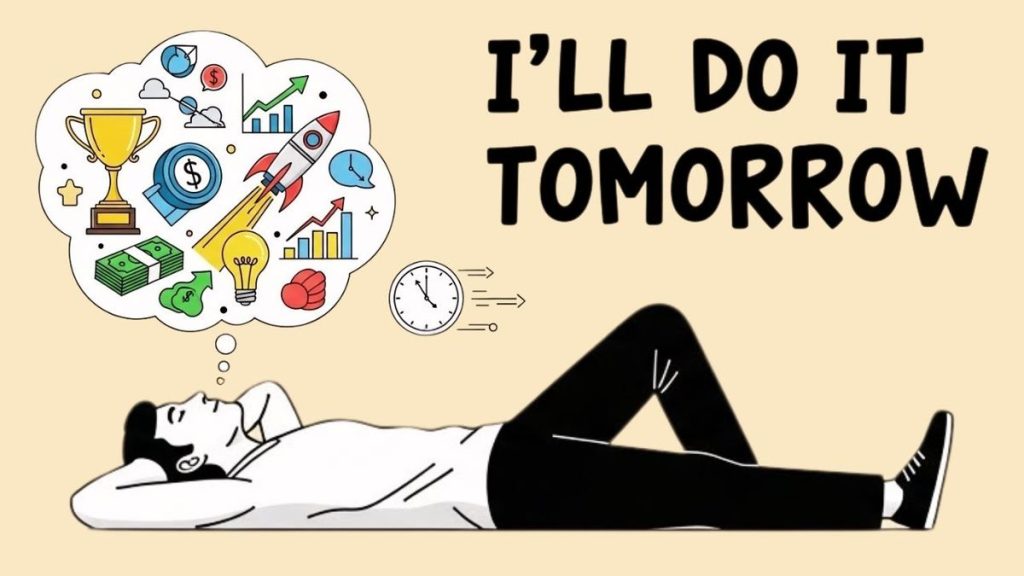
The Problem Isn't Always Procrastination
The Gap Between Knowing and Doing
This is the story of a government major who had to submit a 90-page thesis as part of his college degree.
He had months to complete the task and he had a clear PLAN. Start early. Break the work into smaller tasks. Make steady progress.
Yet, day after day, the work remained untouched. With plenty of time left, there was always something easier to do. Be it browse the internet, explore a new idea, or simply decide to start tomorrow.
And then the deadline arrived.
3 days before his 90-page senior thesis was due, he finally began. He wrote almost continuously for 72 hours, including two all-nighters, just to submit it. He submitted it, but the result was far below what he had intended.
The student was Tim Urban, the writer behind Wait But Why.
The Intention-Action Gap
A gap that results from misalignment between one’s values, attitudes, intentions & their actions. There are 2 major ways this comes to be. The first cause is when you prioritize an immediate reward, like a dopamine boost, over something healthier and more favourable. The second cause is high ambition without a plan in place.
You think, “Tomorrow onwards, I will walk 10K steps a day,” then expect yourself to follow through, only to be demotivated when your feet hurt midway through day 1.
Approximately 92% of people give up their goals midway, leaving only 8% who stay consistent throughout and are successful in their ventures. Roughly 2000 years ago, the Greek historian Polybius (circa 200–118 BCE) noted that, ‘…some men, like bad runners in the stadium, abandon their purposes when close to the goal; while it is at that particular point, more than at any other, that others secure the victory over their rivals’ (Histories, Book 16, chapter 28; Polybius, 2012).
Observers of human nature thus appear to have long recognized that people differ in the enactment of their intentions.
This gap affects your personal goals, And the world around you too...
The intention-action gap can be the reason behind increasing pollution. Despite a high education rate, despite politically aware citizens, there is less goal pursuits.
Find Your Way Out Using the cOM-B model
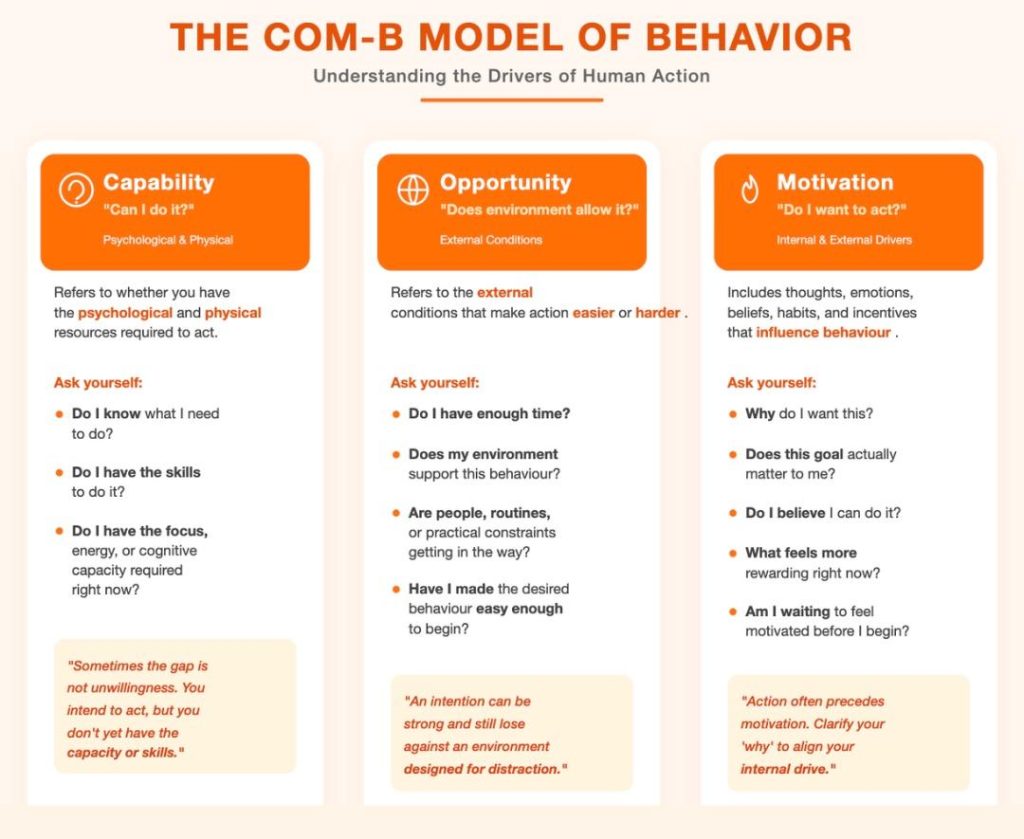
Having an intention is only the starting point. Whether that intention becomes a behaviour depends on 3 conditions:
1. Capability: Can I do it?
2. Opportunity: Does my environment allow it?
3. Motivation: Do I want to act? What is driving me?
answers this: What is missing between my intention and my action?
What are some other ways to bridge the gap?
Achieving one’s goals requires that certain goal directed behaviors are instituted, but people are often unsuccessful in either initiating or maintaining these behaviors.
The problems of initiating and maintaining goal directed behavior can be addressed by using the implementation intention process.
It is easy to set a goal intention, usually said like “I want to have my own business.” “I want to loose weight.”
Implementation intentions, on the other hand, are specific. They are phrased in the following way: “When situation X arises, I will do action Y!”
Where goal intentions are more general and abstract, implementation intentions are much more concrete and procedural.
You come home and fall into bed, scrolling on social media. You forget that you had household chores and fall asleep. The next day, you frown, doing the chores before work in a hurry.
A solution could be:
IF I get home before 8:00, THEN I will immediately clean up my room for 15 minutes.
IF I complete this task before its deadline, THEN I will have tea before going home.
The implementation intention process is hence a helpful tool for the intention-action gap, especially for people who have issues with motivation. This framework provides you with a reason to complete your task that is not rooted in intrinsic or extrinsic motivations, but rather contingent on another unavoidable task. This makes it easier to follow through, especially when tasks are clumped together. For example, if your laundry needs to be folded away and you need to wash and dry a new batch in the machine, try something like this:
IF I finish folding this batch of laundry after the machine finishes washing the new batch, THEN I will also have to immediately dry the new batch.

A solution could be:
IF I get home before 8:00, THEN I will immediately clean up my room for 15 minutes.
IF I complete this task before its deadline, THEN I will have tea before going home.
The implementation intention process is hence a helpful tool for the intention-action gap, especially for people who have issues with motivation. This framework provides you with a reason to complete your task that is not rooted in intrinsic or extrinsic motivations, but rather contingent on another unavoidable task.
This makes it easier to follow through, especially when tasks are clumped together.
start today
Ready to move from intention to action?
If you struggle with procrastination, motivation, goal setting, or following through on your intentions, understanding the psychology behind the intention-action gap can be a useful starting point.